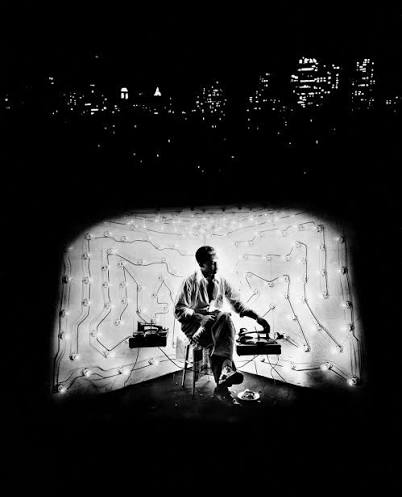
Use me, to your will, your deepest desires, I am the means to your unimproved ends. But do it only with maddening laughter — in awareness of your wicked curvature.
Invisible Man by Ralph Ellison is both commentary-revelation and prophecy. Commentary in that it captured the life of an Afro-American in his home country, in a deeply sensuous way, and perhaps inadvertent prophecy in it’s description of an alienation that is rife in the late 20th, and 21st century labour markets. The eerie feeling of the non-existence of life as a proletarian; both necessary yet devoid of social recognition. Who would have thought that forms of segregation pioneered on Afro-Americans would creep into the lives of almost every worker. How strange is the punishment. It shouldn’t escape us that Ellison’s man is affected twice over, both discriminated against as a being, and a worker toiling his way through.
An event which, for me, describes this racial dehumanisation exceptionally, is the protagonists recovery in hospital after his work accident. Dazed and barely awake, he finds himself immobilised, listening in on hospital staff discussing whether he should receive a lobotomy for his “troubled behaviour”. As shocking as this is, it is the casual manner in which the following unfolds that disgusted me most. Laying in the metal cage — some sort of an electrocution device — in the most vulnerable moment of this life, he cannot even feel safe — he cannot even be recognised as a suffering, unwell being in need of protection, love and care. The medical staff comment on how ’they can all dance’ as he receive waves of electricity — a joke of monstrosity. And ‘here I am, what more but a joke in this world’. Both everything and nothing at once. An insatiable untrustworthy brute, yet also a fiddling confused clown. Tended to with the skepticism suited for an encounter with a wounded animal, wrapping that broken bird up in bandage for duties sake, if only because of a latent Christian guilt.
“Have you no soul?” Is a frequent reflex that jolts forwards as you read this book.
Contained here are painful lessons on the dehumanizing toll of being another’s plan, a variable in their calculus. Not necessarily part of a greater plan, but the plan itself. In these plans is a rotten seriousness. One looks the other in the eyes, and there is deception and control passing between glances, often in a one way fashion. Yet they both press forwards, as if all is well. Ellison tells us that these plans are not themselves fallacious. Indeed, seeking political power with the aim of helping impoverished individuals is a legitimate drive, however, it would appear to me that it is these goals, when sought in a myopic, insular way, pursued without feedback and deliberation, without the input of those who will be most affected by them, which is unforgivable. There is so much that can go sideways when there is a doctrinaire application of a strategy that was always supposed to be elastic - both the capitalist and communist are indicted for this. So how do we break out from this hypnosis? Ellison gives us an answer. Simply listening to comrades is the necessary beginning. However, in this book, being listened to is about the hardest thing possible. Made up minds pass swiftly through conversations.
Our plan makers are chasing fantasies, each in their own way. Think of Norton’s early remarks; “your people are my destiny”. Here always, my destiny. Bledsoe’s self righteous pursuit of quote on quote race spokesmanship. You are nothing unless you make him look better in the eyes of the bourgeoise. A paleskin cheating wife so possessed by the idea of sleeping with a colored man that she forgets reality itself. A big black brute to ‘shake her down’. Perhaps too, our dear capitalist, chasing that fantasy of the obedient, dehumanized worker. Our protagonist too, chasing after different results, is perhaps himself, running after a fantasy. Fantasy of deliverance in white America? I am not sure, though I am patiently listening.
This feeling is magnified by the very few instances where the invisible man’s name is actually used in the work (if at all?!). As readers we are left wondering, does anybody see him for him, or is he always an object? We become beings through recognition, but this recognition, except for in a few heart breaking instances, is only a partial recognition — I recognise you as a potential object — closing the door to recognition as an actual embodied being. You are a means, not an end. But we know in ourselves that we are both the beginning and the end. In this sense one is instrumentalised, transformed into an instrument of others. All throughout, it feels as though it is only Mary who has some selfless care for the invisible man.
Deep into the book, once the invisible man has been through this cycle , naturally, he develops feelings of suspicion, paranoia, cynicism; quite typical of disaffection where your desires cannot be communicated with anyone who will listen. The paralyzing awareness of knowing that you are a cog in anothers plans, yet, blind to your position in the whole configuration. The feeling of being thought about, compelled and moved to act, and mostly powerless to do otherwise. As a proletarian, I couldn’t help but feel that Ellison brings into focus our present condition. Are we not all, to certain degrees, drifting between the worlds of various decision makers, funnelled and pushed through with minimal friction. Yes, OK’ing our way amongst it all. Only in our quite moments of disappointment do we realise our invisibility. A shameful realisation that we yearn for recognition from those unworthy? It is for this reason that so many of us dream of an escape from the labour market. To know that one was denied recognition once more due to the color of ones skin is intolerable. Though, race and labor were always siblings.
I’ll finish these thoughts by sharing some beautiful passages on the ideas of moving within and adjacent to history — the three young men on the train, emigres from the South, wet and glistening.
I wandered down the subway stairs seeing nothing, my mind plunging. The subway was cool and I leaned against a pillar, hearing the roar of trains passing across on the other side, feeling the rushing roar of air. Why should a man deliberately plunge outside of history and peddle an obscenity, my mind went on abstractedly. Why should he choose to disarm himself, give up his voice and leave the only organization offering him a chance to “define” himself? The platform vibrated and I looked down. Bits of paper whirled up in the passage of air, settling quickly as a train moved past. Why had he turned away? Why had he chosen to step off the platform and fall beneath the train? Why did he choose to plunge into nothingness, into the void of faceless faces, of soundless voices, lying outside history? I tried to step away and look at it from a distance of words read in books, half- remembered. For history records the patterns of men’s lives, they say: Who slept with whom and with what results; who fought and who won and who lived to lie about it afterwards. All things, it is said, are duly recorded—all things of importance, that is. But not quite, for actually it is only the known, the seen, the heard and only those events that the recorder regards as important that are put down, those lies his keepers keep their power by. But the cop would be Clifton’s historian, his judge, his witness, and his executioner, and I was the only brother in the watching crowd. And I, the only witness for the defense, knew neither the extent of his guilt nor the nature of his crime. Where were the historians today? And how would they put it down?
I stood there with the trains plunging in and out, throwing blue sparks. What did they ever think of us transitory ones? Ones such as I had been before I found Brotherhood—birds of passage who were too obscure for learned classification, too silent for the most sensitive recorders of sound; of natures too ambiguous for the most ambiguous words, and too distant from the centers of historical decision to sign or even to applaud the signers of historical documents? We who write no novels, histories or other books. What about us, I thought, seeing Clifton again in my mind and going to sit upon a bench as a cool gust of air rolled up the tunnel.
A body of people came down the platform, some of them Negroes. Yes, I thought, what about those of us who shoot up from the South into the busy city like wild jacks-in-the-box broken loose from our springs—so sudden that our gait becomes like that of deep-sea divers suffering from the bends? What about those fellows waiting still and silent there on the platform, so still and silent that they clash with the crowd in their very immobility; standing noisy in their very silence; harsh as a cry of terror in their quietness? What about those three boys, coming now along the platform, tall and slender, walking stiffly with swinging shoulders in their well-pressed, too-hot-for-summer suits, their collars high and tight about their necks, their identical hats of black cheap felt set upon the crowns of their heads with a severe formality above their hard conked hair? It was as though I’d never seen their like before: Walking slowly, their shoulders swaying, their legs swinging from their hips in trousers that ballooned upward from cuffs fitting snug about their ankles; their coats long and hip-tight with shoulders far too broad to be those of natural western men. These fellows whose bodies seemed—what had one of my teachers said of me? —“You’re like one of these African sculptures, distorted in the interest of a design.” Well, what design and whose?
I stared as they seemed to move like dancers in some kind of funeral ceremony, swaying, going forward, their black faces secret, moving slowly down the subway platform, the heavy heel-plated shoes making a rhythmical tapping as they moved. Everyone must have seen them, or heard their muted laughter, or smelled the heavy pomade on their hair—or perhaps failed to see them at all. For they were men outside of historical time, they were untouched, they didn’t believe in Brotherhood, no doubt had never heard of it; or perhaps like Clifton would mysteriously have rejected its mysteries; men of transition whose faces were immobile.
I got up and went behind them. Women shoppers with bundles and impatient men in straw hats and seersucker suits stood along the platform as they passed. And suddenly I found myself thinking, Do they come to bury the others or to be entombed, to give life or to receive it? Do the others see them, think about them, even those standing close enough to speak? And if they spoke back, would the impatient businessmen in conventional suits and tired housewives with their plunder, understand? What would they say? For the boys speak a jived-up transitional language full of country glamour, think transitional thoughts, though perhaps they dream the same old ancient dreams. They were men out of time—unless they found Brotherhood. Men out of time, who would soon be gone and forgotten… But who knew (and now I began to tremble so violently I had to lean against a refuse can)—who knew but that they were the saviors, the true leaders, the bearers of something precious? The stewards of something uncomfortable, burdensome, which they hated because, living outside the realm of history, there was no one to applaud their value and they themselves failed to understand it. What if Brother Jack were wrong? What if history was a gambler, instead of a force in a laboratory experiment, and the boys his ace in the hole? What if history was not a reasonable citizen, but a madman full of paranoid guile and these boys his agents, his big surprise! His own revenge? For they were outside, in the dark with Sambo, the dancing paper doll; taking it on the lambo with my fallen brother, Tod Clifton (Tod, Tod) running and dodging the forces of history instead of making a dominating stand. A train came. I followed them inside. There were many seats and the three sat together. I stood, holding onto the center pole, looking down the length of the car. On one side I saw a white nun in black telling her beads, and standing before the door across the aisle there was another dressed completely in white, the exact duplicate of the other except that she was black and her black feet bare. Neither of the nuns was looking at the other but at their crucifixes, and suddenly I laughed and a verse I’d heard long ago at the Golden Day paraphrased itself in my mind:
Bread and Wine,
Bread and Wine,
Your cross ain’t nearly so
Heavy as mine…
And the nuns rode on with lowered heads. I looked at the boys. They sat as formally as they walked. From time to time one of them would look at his reflection in the window and give his hat brim a snap, the others watching him silently, communicating ironically with their eyes, then looking straight ahead. I staggered with the lunging of the train, feeling the overhead fans driving the hot air down upon me. What was I in relation to the boys, I wondered. Perhaps an accident, like Douglass. Perhaps each hundred years or so men like them, like me, appeared in society, drifting through; and yet by all historical logic we, I, should have disappeared around the first part of the nineteenth century, rationalized out of existence. Perhaps, like them, I was a throwback, a small distant meteorite that died several hundred years ago and now lived only by virtue of the light that speeds through space at too great a pace to realize that its source has become a piece of lead… This was silly, such thoughts. I looked at the boys; one tapped another on the knee, and I saw him remove three rolled magazines from an inner pocket, passing two around and keeping one for himself. The others took theirs silently and began to read in complete absorption. One held his magazine high before his face and for an instant I saw a vivid scene: The shining rails, the fire hydrant, the fallen policeman, the diving birds and in the mid- ground, Clifton, crumpling. Then I saw the cover of a comic book and thought, Clifton would have known them better than I. He knew them all the time. I studied them closely until they left the train, their shoulders rocking, their heavy heel plates clicking remote, cryptic messages in the brief silence of the train’s stop.
Remarkable.
When all is said and done, living underground, he does recognize that despite the past, self affirmation is possible, he IS himself. The work is tortuous and rattling, though still one of hope.